
On this page
- Why do gutters sag?
- How are sagging gutters fixed?
- Spikes or hidden hangers?
- Why does weight matter under pines?
- How do I tell how bad a sag is?
- Re-hang or replace?
- Why do sags come back?
- What does good re-hanging look like afterwards?
- How to prevent sagging
- Sagging on historic houses
- What affects the price of re-hanging?
Why do gutters sag?
Gutters sag because the fixings or the wood behind them give way under load. Redding Brothers Gutters connects callers with independent local gutter contractors, who give the estimates and do the work. The common causes:
- Spike-and-ferrule fixings on older gutters, which work loose over years of heat and movement.
- Hangers too far apart, especially on long runs.
- Rotten fascia that no longer holds a screw.
- Weight: wet pine straw, leaves and standing water.
- Ladders leaned against the gutter.
How are sagging gutters fixed?
- Clean the gutter so its true shape shows.
- Check the wood with a probe along the run.
- Replace soft fascia where found.
- Snap a new pitch line.
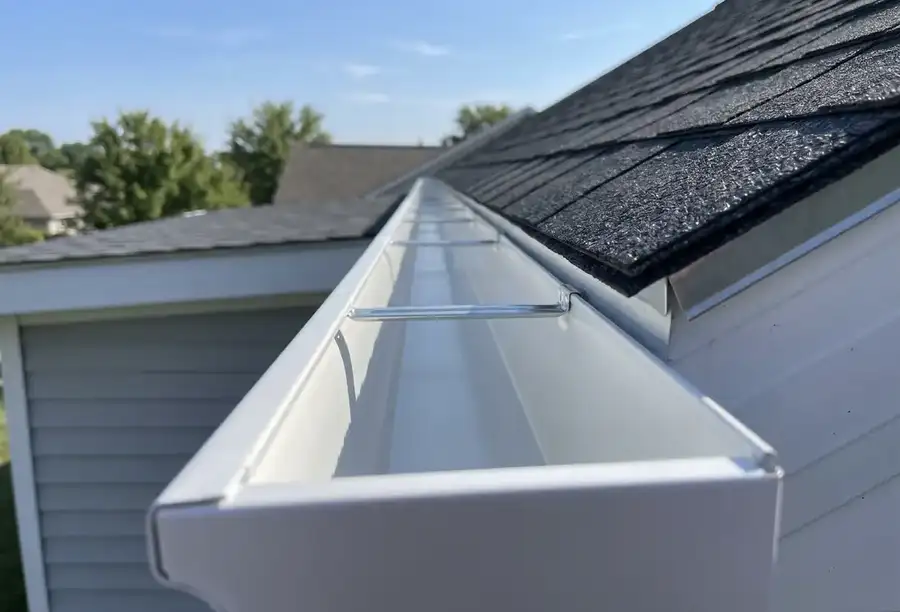
- Fit hidden hangers every 2 feet or closer, screwed into sound wood.
- Lift the gutter to the line.
- Water-test and check for standing water.
Spikes or hidden hangers?
| Fixing | How it works | Problem |
|---|---|---|
| Spike and ferrule | Long nail through the gutter into the fascia | Works loose; leaks around the hole |
| Strap hanger | Strap under the shingles | Disturbs roofing |
| Hidden screw-in hanger | Clip inside the gutter, screwed through the back | Best hold; invisible |
Why does weight matter under pines?
A gutter full of soaked pine straw weighs far more than an empty one, and needles hold water for days after a storm. On old spikes that weight works the nails out a little with every rain. Close hanger spacing into sound wood is what lets a gutter carry it, and guards stop the load building up. See pine straw, oak leaves and gutters.
How do I tell how bad a sag is?
| Sign | Severity |
|---|---|
| Slight dip with a little standing water | Early; re-hang soon |
| Visible gap between gutter and fascia | Fixings failing |
| Gutter tilted forward | Hangers pulled out |
| Gutter hanging loose at one end | Urgent; keep people clear |
| Spikes backing out along the run | Whole run needs re-hanging |
Re-hang or replace?
| Situation | Better choice |
|---|---|
| Straight metal, sound wood | Re-hang |
| Straight metal, soft wood in places | Repair wood, re-hang |
| Kinked or creased metal | Replace that run |
| Old steel or sectional | Replace |
See gutter replacement.
Why do sags come back?
| Cause | Fix that lasts |
|---|---|
| Rotten wood | Replace the wood first |
| Wide spacing | Hangers every 2 feet |
| Debris left to build up | Clean regularly or fit guards |
| Ladders leaned on the gutter | Use stand-offs |
What does good re-hanging look like afterwards?
- No standing water an hour after rain.
- No gap between gutter back and fascia.
- Even hanger spacing, visible from inside the gutter.
- A straight line when sighted along the run.
- Old spike holes sealed.
How to prevent sagging
- Keep gutters clear of pine straw, or fit guards.
- Never lean ladders on the gutter.
- Check after big storms.
- Fix leaks that wet the fascia.
- Use hidden hangers every 2 feet.
Sagging on historic houses
On older houses, a sagging half-round gutter is often caused by brackets fixed into soft wood, or brackets spaced too far apart. Built-in box gutters do not sag in the same way, but their bases can rot and dip, so water ponds. Both need the wood fixed before the metal.
What affects the price of re-hanging?
| Factor | Effect |
|---|---|
| Length of run | Base cost |
| Number of hangers | Materials and time |
| Fascia repair | Carpentry |
| Stories and roof pitch | Access |
| Removing old spikes | Time; sealing holes |
Re-hanging is usually much less than replacement where the metal is sound.