
On this page
What does a gutter installation include?
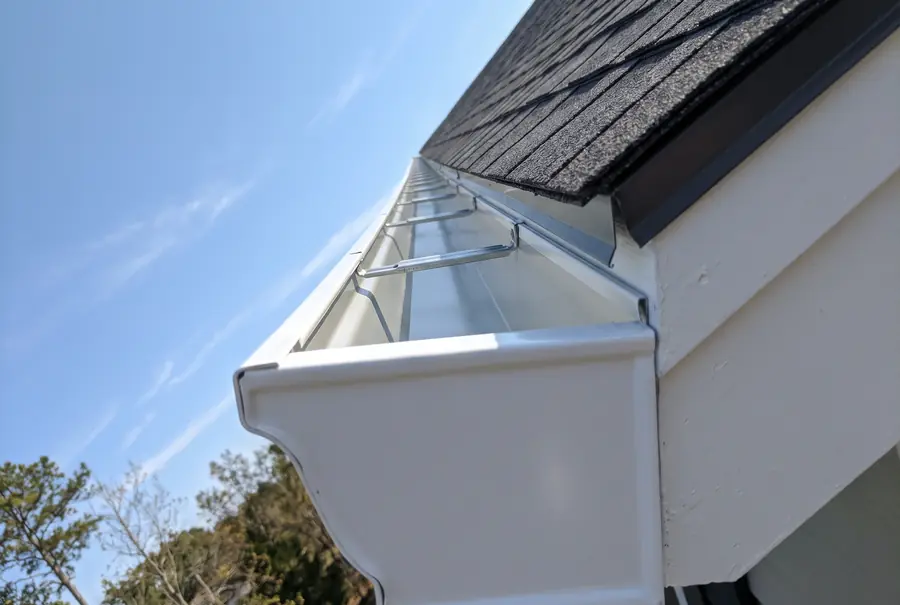
A gutter installation covers everything between the shingle edge and the ground where the water lands: the trough, its hangers, the outlets, the downspouts and the discharge. Redding Brothers Gutters connects callers with independent local gutter contractors, who give the estimates and do the work. A complete job normally covers:
- Measuring each eave and the roof area and valleys draining to it.
- Checking the wood. Fascia and rafter tails are probed; rot is common behind old gutters on Macon's older houses.
- Forming on site. A machine on the truck rolls seamless gutter to the exact length.
- Hanging and pitching on hidden hangers with a steady fall to each outlet.
- Downspouts, sized, strapped and led away from the house. See downspouts.
- Sealing and testing every corner, end cap and outlet.
- Removal of the old gutter and spikes.
How is a good installation done?
- Survey the house. Roof pitch, valleys, which trees overhang, and where water currently lands.
- Check the ground. Where each downspout can discharge without running back to the foundation.
- Repair the wood. Soft fascia comes out and primed board goes in.
- Fit drip edge where the roof has none, so water drops into the gutter, not behind it.
- Snap a fall line of about a quarter inch in 10 feet; long runs drain to both ends.
- Form, cap and hang each run on hidden screw-in hangers.
- Rivet and seal corners on the inside, on clean, dry metal.
- Fit downspouts and run water through every one.
Which parts make up the system?
| Part | Job | Ask for in Macon |
|---|---|---|
| Gutter | Catches water at the eave | Seamless aluminum; 0.032 inch on long runs and under trees |
| Hidden hanger | Holds the gutter to the fascia | Screw-in, every 2 feet or closer |
| End cap | Closes a run | Crimped and sealed inside |
| Miter | Joins runs at a corner | Riveted and sealed |
| Outlet | Feeds the downspout | Wide-mouth; pine straw bridges small ones |
| Downspout | Carries water down | 3x4 inch below valleys and under pines |
| Extension or drain | Moves water away | Off the foundation and off the neighbor's lot |
| Drip edge | Guides water into the gutter | Lapped over the gutter back |
| Guard | Keeps debris out | Micro-mesh under pines |
What do Macon conditions mean for the design?
Thunderstorm rain. Macon's climate normals show 46.91 inches a year on about 108 days. Much of the summer total comes in short, heavy storms, and in July 1994 Tropical Storm Alberto dropped 24 inches. Gutters are sized for the worst burst, which means enough downspouts and wide outlets more than a bigger trough everywhere.
Pines, oaks and cherries. Pine needles fall all year and mat into the trough. Oaks drop leaves in fall, and the city's famous Yoshino cherries shed petals each March. Wide outlets, 3x4 downspouts and guards keep the system open. See pine straw, oak leaves and gutters.
Historic houses. Macon has 15 National Register historic districts and more than 6,000 historic buildings. On these houses the profile and metal should suit the period. See gutters for Macon's historic homes.
Clay and crawl spaces. Middle Georgia's red clay soaks slowly and washes easily. Water released against a wall soaks the crawl space or the slab edge; water released onto bare clay cuts a channel. Downspout placement matters. See downspout drainage.
Which profile and metal should I choose?
| Choice | Strengths | Limits | More |
|---|---|---|---|
| Aluminum K-style | No rust; many colors; lowest cost | Dents under limbs and ladders | Aluminum gutters |
| Painted steel K-style | Stiffest | Rusts where the coating fails in humid weather | Metals compared |
| 6-inch K-style | More capacity, bigger outlets | Heavier; can look big on small eaves | 6-inch gutters |
| Half-round | Suits historic homes | Holds less than K-style | Half-round gutters |
| Copper | Very long life; soldered joints | Highest cost | Copper gutters |
What happens on installation day?
| Time | Step | What you will see |
|---|---|---|
| Morning | Old gutters and spikes removed | Debris bagged; fascia exposed |
| Morning | Wood checked and repaired | New board where rot is found |
| Midday | Coil loaded; runs formed | Long lengths laid out on the driveway |
| Afternoon | Runs hung, corners joined | Ladders at each eave |
| Afternoon | Downspouts fitted | Water run through each one |
| End of day | Clean-up and walk-round | Old metal hauled away |
Crews often start early in summer to avoid the hottest part of the day, and work around afternoon thunderstorms.
What should a written quote include?
- Feet of gutter, size and profile
- Metal, thickness and color
- Hanger type and spacing
- Number, size and position of downspouts, and where each discharges
- Fascia repair, priced per foot
- Guards, if included, by product name
- Removal and disposal of the old system
- Warranty terms, in writing
- The contractor's business name, business license and insurance details
What it costs
Published national guides put seamless aluminum at about $9 to $14 a foot installed for 5-inch and $11 to $17 for 6-inch, steel at $12 to $20 and copper at $29 to $40. Those are national ranges, not Macon quotes. Height, steep roofs, fascia repair, guards and drain work all move the number. The cost guide has sources and worked examples.
Ballpark for your roofline
$1,440 to $2,240
Arithmetic from national price ranges (Angi aluminum gutter cost guide, This Old House seamless gutter cost guide), not a local quote. The number of corners and downspouts, fascia repairs and awkward access all move it. A contractor who has measured your house gives the real figure.
Installation pages
- Seamless gutters: formed on site, no joints along the run
- 6-inch gutters: for big roofs and valleys
- Half-round gutters: for historic homes
- Copper gutters: soldered and long-lived
- Aluminum gutters: the everyday choice
- Downspouts: sizing, placement and drainage